 Welcome to Cambodia – A land of Rich History and Culture
Cambodia, officially known as the Kingdom of Cambodia, is a Southeast Asian gem on the Indochina Peninsula, bordered by Thailand, Laos, Vietnam, and the Gulf of Thailand.
Home to over 17 million people, Cambodia offers travelers authentic cultural immersion and vibrant local experiences.
The official religion, Theravada Buddhism, shapes much of the country’s spiritual life, alongside a tapestry of minority groups including Vietnamese, Chinese, Chams, and hill tribes.
The Rise of Khmer Empire – Cambodia’s Golden Era
In 802 AD, Jayavarman II united the Khmer princes under the name “Kambuja,” marking the rise of the legendary Khmer Empire.
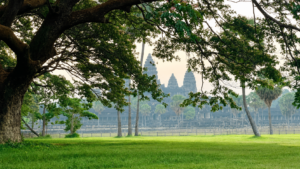
For over 600 years, the empire spread power, wealth, and architectural wonders across Southeast Asia, leaving behind iconic sites like Angkor Wat a UNESCO World Heritage Site and a centerpiece for authentic Cambodia tours and heritage explorations today.
Colonial Legacy and Road to Independence
After centuries of shifting rule, Cambodia became a French protectorate in 1863, reclaiming territories and reshaping its national boundaries. Independence followed in 1953, setting the stage for a modern Cambodia navigating a complex history of wars, coups, and rebuilding efforts.
Dark Chapters – Khmer Rouge and Recovery
The tragic era of the Khmer Rouge (1975–1979) remains a defining part of Cambodia’s story, with echoes still felt today. Travelers interested in responsible tourism Cambodia can engage with this history through ethical visits to memorials, museums, and survivor-led experiences that honor resilience and remembrance.
Challenges and Triumphs – Cambodia Today
Despite challenges like poverty, corruption, and environmental threats such as deforestation and habitat destruction, Cambodia stands as one of Asia’s fastest-growing economies. With booming sectors in agriculture, textiles, and tourism, the country offers sustainable Cambodia travel opportunities that combine economic progress with cultural preservation and environmental awareness.
Why Travel to Cambodia?
For those seeking customized Cambodia travel experiences, the country delivers authentic local tours, cultural immersion, and the chance to taste local cuisine Cambodia is famous for. From breathtaking temples to intimate village life, Cambodia invites travelers to connect deeply with its landscapes, people, and stories.
 Cambodia’s wet season comes courtesy of the southwest monsoon, which blows from May to October, bringing with it some three-quarters of Cambodia’s annual rainfall.
Not surprisingly, wet season is characterized by rain, and during the peak of wet season from July to September it can rain every day.
Rainy days however tend to have a few hours of heavy rain rather than being all-day downpours, though the latter do sometimes occur – you will get wet travelling in a Cambodian wet season.
Aside from getting drenched, the main disadvantage of travelling in wet season in Cambodia relates to flooding and degraded road conditions. The bulk of roads in Cambodia are dirt and in wet season they turn to heavily rutted and pot-holed mud pits. Travelling in rural areas, particularly the north and northeast of the country, can be slowed considerably. You will still be able to go just about anywhere; it will just take longer.
 Cambodia’s dry season runs from October to April, when the dusty northeast monsoon arrives. Blowing like a hairdryer set to high, the northeast monsoon dries out the country fast. While November and January are quite cool (high C20s) by April, the weather is scorching and oh-so- dry it will take your breath away.
Characterized by heat and dust, this season coincides with Cambodia’s peak tourist season – travelers arrive in their droves between November and January to take advantage of the lack of rain and relative cool.
By March, travelling can be uncomfortable and hot, while April can be excruciating. As the country dries out, badly rutted roads get graded and trip times improve dramatically, though they get incredibly dusty.
Cambodia’s beach strips at Kep, Sihanoukville and Ko Kong bask in brilliant sunshine with clear calm waters – if you’re a beach bum, dry season is the season for you.

Cambodia is a country in mainland Southeast Asia, bordering Thailand, Laos, Vietnam, and the Gulf of Thailand. It covers an area of 181,035 km² and lies entirely within the tropical Indomalaya ecozone and the Indochina Time Zone (ICT).
The country is characterized by broad, fertile central lowlands that include the Tonlé Sap basin, the lower Mekong River floodplains, and the Bassac River plain.
These lowlands are surrounded by mountain ranges to the north, east, southwest, and south, while the plains extend southeastward into Vietnam.
The Mekong River, at 486 km long, is Cambodia’s most important waterway, flowing from north to south and feeding extensive wetlands and the Tonlé Sap Lake, which expands dramatically during the rainy season.
The rich sediments deposited by annual flooding make the lowlands ideal for agriculture, where much of the population lives.
Southern and southwestern Cambodia form a 443 km coastline along the Gulf of Thailand, featuring sandy beaches, mangrove forests, bays, headlands, and more than 50 offshore islands. The country’s highest point is Phnom Aural, rising 1,810 meters above sea level.
Cambodia has a predominantly tropical climate with two main seasons – wet and dry. Temperatures and humidity remain high year-round, with heavier rainfall along the southern and western coasts influenced by the southwest monsoon.
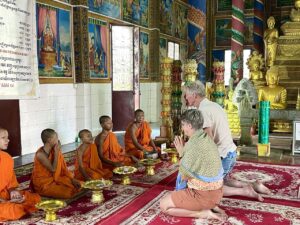 Theravada Buddhism is the prevailing official religion in Cambodia and approximately ninety percent of the population is Buddhist. Islam, Hinduism and Christianity are also embraced in Cambodia.
Since Buddha statues and images represent the revered Buddha, visitors are asked to treat all such statues and images with respect, so as not to offend local people.
In Cambodia, regardless of religion, the country maintains a harmonized state.
Be respectful when entering a temple just as you would when entering any house of worship. Religious objects such as statues of Buddha, offerings, altars, etc. may not be touched or moved.
Shoes and hats must be removed before entering a temple, with the shoes being left outside Shirts must be worn inside temples, and one’s shoulders should be covered.
One should not sit in a temple with the feet pointed toward a Buddhist statue. It is customary to sit facing the statue with the legs folded under you.
Please do not bother monks during times of prayer. Always be respectful when taking photos of monks, especially during the morning alms procession.
Do not touch the monks and their robes, if a monk agrees to pose for a picture with you, please pose respectfully (ex. do not put your arm around the monk).
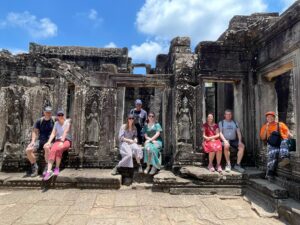 In Southeast Asia people dress rather conservatively. Men usually wear long pants and long- sleeved shirts, and women do not usually wear low-cut or revealing clothing.
Visitors are not necessarily expected to dress like local people, but common sense and a respect for local custom should guide you in how you dress. There are no nude beaches in Southeast Asia and being nude or topless in public at the beach or pool is not done.
It is customary to remove one shoes when going into someone’s house. Also, some guesthouses require guests to leave their shoes at the entrance.
If you are ever unsure if you need to remove your shoes, ask someone, or look for other shoes left at the entrance.

Siem Reap (Siĕm Réab [siəm riəp]) is the second-largest city of Cambodia, as well as the capital and largest city of Siem Reap Province in northwestern Cambodia.
Siem Reap possesses French-colonial and Chinese-style architecture in the Old French Quarter and around the Old Market. The city is a major hub for tourism in Cambodia due to its close proximity to the ancient temples of Angkor constructed during the Khmer Empire.
In and around the city there are museums, traditional Apsara dance performances, souvenir and handicraft shops, silk farms, rice paddies in the countryside, fishing villages and a bird sanctuary near Tonlé Sap, and a cosmopolitan drinking and dining scene.
Siem Reap was named the ASEAN City of Culture for the period 2021–2022 at the 9th Meeting of the ASEAN Ministers Responsible for Culture and Arts (AMCA) organized on Oct 22, 2020.

The name “Siem Reap” can be translated to mean ‘defeat of Siam’ (Siem in Khmer) and is commonly taken as a reference to an incident in the centuries-old conflict between the Siamese and Khmer kingdoms, although this is probably apocryphal.
According to oral tradition, King Ang Chan (1516–1566) had named the town “Siem Reap” after he repulsed an army sent to invade Cambodia by the Thai king Maha Chakkraphat, in 1549.
Scholars such as Michael Vickery consider this derivation to be simply a modern folk etymology and maintain that while the names Siem Reap and Chenla, the old Chinese name for Cambodia, may perhaps be related, the actual origin of the name is unknown.
The traditional tale claims that King Ang Chan of Cambodia tried to assert greater independence from Siam, which was then struggling internally.
From the 16th to the 19th centuries, infighting among the Khmer nobility led to periodic intervention and domination by both of Cambodia’s more powerful neighbors, Vietnam and Siam.
Siem Reap, along with Battambang (Phra Tabong) and Sisophon, major cities in northwest Cambodia, was under Siamese administration and the provinces were collectively known as Inner Cambodia from 1795 until 1907, when they were ceded to French Indochina.
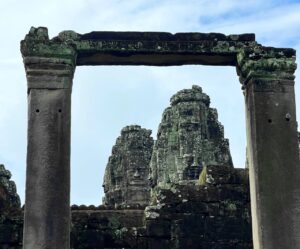
Siem Reap was little more than a village when French explorers such as Henri Mouhot “re-discovered” Angkor in the 19th century. However, European visitors had visited the temple ruins much earlier, including António da Madalena in 1586.
In 1901, the École française d’Extrême-Orient (EFEO) (‘French School of the Far East’) began a long association with Angkor by funding an expedition into Siam to the Bayon. The EFEO took responsibility for clearing and restoring the whole site.
In the same year, the first Western tourists arrived in Angkor, a total of about 200 in just three months. Angkor had been “rescued” from the jungle and was assuming its place in the modern world.
With the acquisition of Angkor by the French in 1907 following a Franco-Siamese treaty, Siem Reap began to grow.
The Grand Hotel d’Angkor opened in 1929 and the temples of Angkor became one of Asia’s leading draws until the late-1960s, when civil war kept tourists away. In 1975, the population of Siem Reap, like all other Cambodian cities and towns, was driven into the countryside by the communist Khmer Rouge.
Siem Reap’s recent history is colored by the horror of the Khmer Rouge regime. Since Pol Pot‘s death in 1998, however, relative stability and a rejuvenated tourist industry have revived the city and province.
Siem Reap now serves as a small gateway town to the world heritage site of Angkor Wat. In recent years, the city has regularly ranked in the top ten for “Best Destination” lists produced by entities such as TripAdvisor, Wanderlust Magazine, and Travel Leisure.

Tourism is a very important aspect of the economy of Siem Reap: it was estimated in 2010 that over 50% of jobs in the town were related to the tourism industry.
The city has seen a massive increase in tourist arrivals in the decades since the end of the Khmer Rouge era, and businesses centered on tourism have flourished due to the tourism boom.
Visitor numbers were negligible in the mid-1990s, but by 2004, over half a million foreign visitors had arrived in Siem Reap Province that year, approximately 50% of all foreign tourists in Cambodia. By 2018, tourist numbers had reached over 10 million.

THE ANGKOR
Angkor is one of Southeast Asia’s most important and iconic archaeological sites. Spanning approximately 400 km² of forested land, the Angkor Archaeological Park preserves the impressive remains of several capitals of the Khmer Empire, which flourished between the 9th and 15th centuries.
Among its most famous monuments are the majestic Angkor Wat, renowned for its grand scale and exquisite bas-reliefs, and the Bayon Temple at Angkor Thom, celebrated for its countless sculptural faces and intricate decorations.
To safeguard this symbol of Cambodia’s cultural heritage, UNESCO has implemented a comprehensive program to protect the site and its surrounding landscapes.
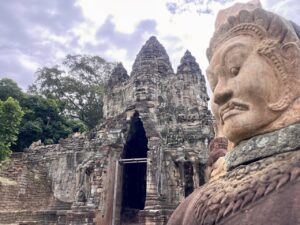 Located in Cambodia’s Siem Reap Province, Angkor Archaeological Park is one of the world’s greatest archaeological treasures, covering over 400 square kilometres. As the heart of the Khmer Empire from the 9th to the 15th centuries, it is home to magnificent temples, ancient cities, reservoirs, and an advanced water management system.
The park’s iconic monuments, including Angkor Wat, Bayon, Ta Prohm, and Preah Khan showcase the finest achievements of Khmer architecture and art. Blending spirituality, engineering, and natural beauty, these masterpieces have influenced the cultural heritage of Southeast Asia for centuries.
A UNESCO World Heritage Site since 1992, Angkor remains a living cultural landscape where local communities continue traditions passed down through generations. Carefully protected and managed by the APSARA National Authority and international conservation partners, Angkor stands today as a remarkable symbol of Cambodia’s history, culture, and enduring legacy.
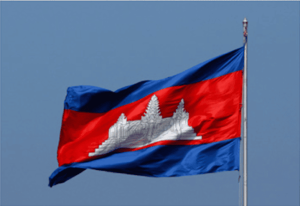
The flag of Cambodia is a striking symbol of the nation’s history and culture. It has three horizontal stripes: blue on top and bottom, with a red stripe in the middle that is twice their height.
At the center of the red stripe is a detailed depiction of Angkor Wat, Cambodia’s iconic temple complex.
Symbolism:
- Blue represents the monarchy and royalty.
- Red stands for the courage and valor of the Cambodian people.
- White Angkor Wat symbolizes religion (Theravada Buddhism), national unity, and the grandeur of Cambodia’s ancient civilization.

The Buddhist flag is a global symbol of faith, peace, and unity among Buddhists. First designed in 1885 in Sri Lanka, it represents the universal principles of Buddhism, transcending nationality or tradition.
Design and Colors:
The flag has six vertical bands, reflecting the aura of the Buddha after enlightenment:
- Blue: Loving-kindness and compassion
- Yellow: The Middle Path and balance
- Red: Blessings from following the Buddha’s teachings
- White: Purity of the Dharma
- Orange: Wisdom
- Combined stripe: Unity of all five colors
Symbolism:
It represents the diversity and unity of Buddhist followers worldwide and is displayed in temples, festivals, and ceremonies to promote peace, tolerance, and spiritual harmony.

The Cambodian Royal Flag, or Royal Standard of Cambodia, is the personal flag of the King and is distinct from the national flag. It is used during royal ceremonies and at royal residences.
The flag features a blue background with the Royal Arms of Cambodia at its center, flanked by two mythical guardians: Gajasingha (lion-elephant) and Rajasingha (royal lion).
Above the arms sits the royal crown, with a sword, scepter, and multi-tiered parasol symbolizing authority, protection, and royalty. A ribbon below bears the Khmer motto: “Nation, Religion, King.”
The blue background represents the monarchy, and the royal arms signify the king’s power, divine protection, and sacred role in Cambodian society. This flag is reserved exclusively for the monarch and the royal household.
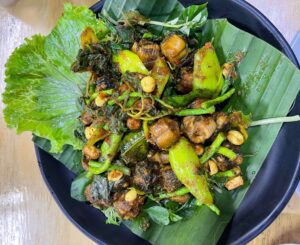 Cambodian cuisine features noodles, soups, grilled and stir-fried dishes, curries, salads, desserts, vegetables, tropical fruits, and rice, the staple of every meal. Recipes are traditionally passed down through generations, preserving a rich culinary heritage of unique flavors and vibrant colors.
A signature of Cambodian cooking is kroeung, a spice paste made from cloves, cinnamon, star anise, nutmeg, cardamom, ginger, galangal, garlic, shallots, lemongrass, cilantro, and kaffir lime leaves.
Meals often include rice accompanied by curries, soups, and stir-fried dishes, with aromatic or glutinous rice served in desserts or salads. Pungent ingredients like pra-hok (fermented fish paste) and kapi (fermented prawn paste) add distinctive flavors to many dishes.
Typically, a Cambodian meal includes rice, at least three other dishes, and a soup (samlor). Flavors sweet, sour, salty, and bitter are balanced harmoniously, sometimes within a single dish, while chili is added to taste, offering a full and subtle culinary experience.
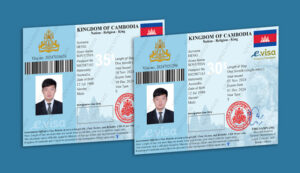 Most travelers require a visa to enter Cambodia. Your passport must be valid for at least six months beyond your visit and have at least one blank page for the visa sticker.
Tourist visas (30 days) are available on arrival at major airports and land borders. The official fee is US$30 for a Tourist Visa and US$35 for a Business Visa, with a completed application form and one passport photo required. Vaccination certificates are not required.
Cambodia also offers a convenient e-Visa through the Ministry of Foreign Affairs website: http://evisa.mfaic.gov.kh.
With the e-Visa, you can apply online without visiting an embassy, submit your details, and pay securely by credit card. The system is fully legitimate and government-supported, with over 55,000 applications approved to date. The platform now supports 25 languages, and e-Visa lanes at checkpoints have expanded to 20 lanes, making entry smoother for travelers.

Phnom Penh is the capital and largest city of Cambodia, serving as the nation’s political, economic, industrial, and cultural center. Its name comes from Wat Phnom, a Buddhist temple, and Lady Penh, the city’s legendary founder. Located at the confluence of the Tonlé Sap and Mekong rivers, it also marks the start of the Bassac River and is home to the Royal Palace, the seat of Cambodia’s monarchy.
Founded in 1372, Phnom Penh became the national capital in 1434 following the fall of Angkor and retained this status intermittently until the French colonial era, when it was modernized and expanded. During Cambodia’s independence, the city earned the nickname “Pearl of Asia” for its French colonial, New Khmer, and Art Deco architecture.
The population grew rapidly in the 1960s and 1970s due to civil war and the Vietnam War, but in 1975 the Khmer Rouge forcibly evacuated the city, leading to persecution, forced labor, and genocide. Phnom Penh remained largely deserted until Vietnamese forces recaptured it in 1979.
Since then, the city has been rebuilt and modernized with international aid and investment. By 2019, Phnom Penh’s population exceeded 2 million, representing about 14% of Cambodia’s total population.
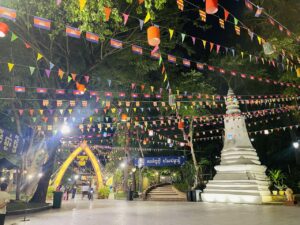
Phnom Penh, Cambodia’s capital, traces its origins back to at least the 5th century AD. Archaeological discoveries in Choeung Ek, southern Phnom Penh, revealed one of Southeast Asia’s earliest kiln sites, producing ceremonial vessels known as kendi from the 5th to 13th centuries.
Excavations also uncovered remnants of ancient village structures, irrigation systems, inscriptions, Shiva lingas, and brick temple foundations dating to the Funan era.
Legend holds that in the late 14th century, a local woman named Lady Penh found a floating Koki tree in the Tonle Sap River containing four Buddha statues and one of Vishnu.
She raised a small hill to house the sacred objects, now known as Wat Phnom, around which the city grew. Phnom Penh became the Khmer capital when King Ponhea Yat moved the seat of government from Angkor Thom after its destruction by Siam.
Throughout the 17th century, Japanese and Portuguese communities settled in the city, which remained the royal capital from 1432 to 1505 before being abandoned due to internal conflicts. Phnom Penh became the permanent capital in 1866 under King Norodom I, who built the Royal Palace.
French colonial authorities developed the city into a modern urban center from the 1870s, constructing houses, public buildings, and infrastructure for trade.
By the 1920s, Phnom Penh earned the nickname the “Pearl of Asia”, with continued growth through railways, an international airport, and modernization under King Norodom Sihanouk.