 Phnom Bros & Phnom Srei – Twin Hills of Culture and History
The two mountains, Phnom Bros (“Man Mountain”) and Phnom Srei (“Woman Mountain”), are located close to each other in Kampong Cham province, Cambodia.
These twin hills are steeped in local folklore, most notably a legend explaining why men must traditionally propose to women in Khmer culture. Beyond their mythological significance, the site also holds deep historical resonance, having been affected during the Khmer Rouge era.
Today, the area has transformed into a scenic and cultural tourism site, attracting visitors for both its natural beauty and spiritual significance.
On Phnom Bros, visitors can find a large Angkorian-style pagoda, a towering stupa, and several funerary stupas, making it not only a peaceful place to relax but also a site of cultural and religious importance.
Phnom Bros (Wat Sovan Kiri Rattanak Phnom Pros)
Phnom Bros is home to Wat Sovan Kiri Rattanak Phnom Pros, a serene Buddhist site that blends historical architecture with modern reconstructions.
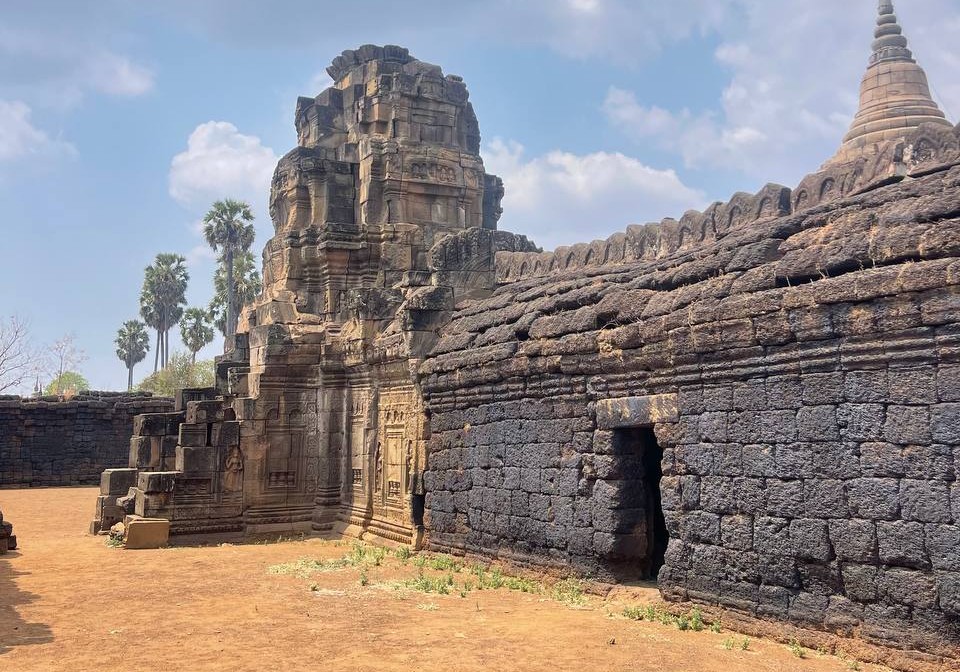
The main stupa was originally constructed in 1918, topped with a copper finial shaped like the four-faced Brahma, allegedly adorned with gemstones. Unfortunately, it was destroyed during the Khmer Rouge era and looted. The stupa was rebuilt in 2001 and today stands as a symbol of resilience and faith.
The site features a large Angkorian-style pagoda, several funerary stupas, and ancient sema stones, some possibly from the original structure. Two lion statues guard the pagoda’s eastern entrance, old, possibly ancient, though their exact age is unclear.
At the base of the hill, visitors will find:
The Phnom Bros Library, topped with four smiling faces reminiscent of Bayon-style Brahma or Avalokiteshvara. Several large Buddhist-themed displays, and a curious recreation of an Angkor-style building, seemingly built for aesthetics or shelter rather than function, a perfect spot for a hammock, if only you brought one.
Phnom Srei: Higher Ground with a View
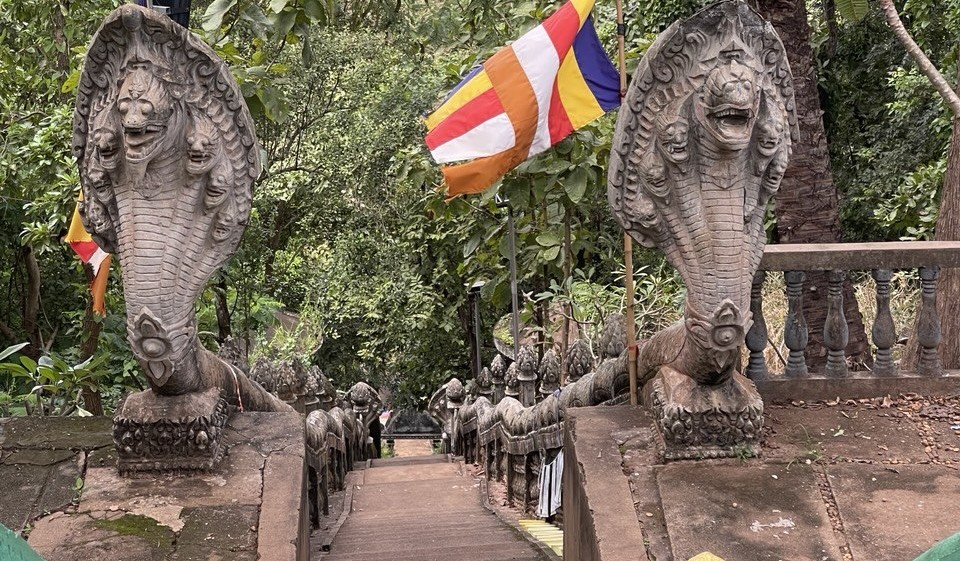
Phnom Srei, the taller of the two hills, offers sweeping views over the surrounding countryside, including Phnom Bei and Phnom Touch, and out toward Kampong Cham city. After a short climb up a flight of stairs, you reach the hilltop where a modern temple now stands.
The old vihara was replaced some time ago, but the original sema stones have been embedded into its walls, preserving a connection to its past. Behind the hall stands an old laterite stupa, weathered but enduring, a quiet spot for reflection.
Phnom Touch
Lesser known but equally rewarding is Phnom Touch (“Small Hill”), a short distance away. It offers: A new prasat (tower sanctuary) with spectacular views, a small pagoda at the summit, again in Angkorian style, a quirky collection of Buddhist-themed sculptures and displays, at one time, Phnom Touch even featured a funicular tram, though it’s unclear if it still operates today.
A Dark Chapter: The Killing Fields Between the Hills
Between Phnom Bros and Phnom Srei lies a site of profound sorrow: one of Kampong Cham’s Khmer Rouge-era killing fields. During the brutal regime (1975–1979), many Cambodians were executed and buried here. Some stupas now serve as memorials to those who died.
This somber location stands in contrast to the surrounding serenity, offering a stark reminder of Cambodia’s tragic past and the resilience of its people.
A Legendary Contest Between the Sexes
According to Khmer folklore, the origins of Phnom Bros and Phnom Srei date back to an epic contest between men and women. In ancient times, it was customary for women to propose to men. However, some women, unhappy with this tradition, devised a clever challenge.
They proposed that if they could build a taller hill than the men before the morning star rose, the custom would be reversed, men would have to seek permission from the woman’s family to marry. The men, confident in their superior strength, accepted the challenge.
As both sides labored through the night, the women played a trick: they hung a lantern high in a tree to mimic the morning star. Fooled by the light, the men stopped working and went to sleep. The women continued, and by dawn, their hill was higher. Thus, Phnom Srei became taller than Phnom Bros, and the tradition was reversed, a man must now ask for a woman’s hand in marriage.
Another lesser-known legend speaks of Queen Srey Ayuthiya, a noble woman so beautiful and powerful that no man dared propose to her. She eventually chose her own husband, setting a precedent for women proposing. The hills are thus bound to this theme of marriage customs, gender roles, and trickery vs. strength.