 Phimeanakas, meaning “Celestial Palace,” is a Hindu temple located within the Royal Palace enclosure of Angkor Thom in Siem Reap, Cambodia.
Though smaller in scale than Angkor’s grand monuments, it holds immense historical and symbolic significance as the royal temple at the heart of the Khmer Empire’s capital.
History of Phimeanakas
The temple was originally constructed in the late 10th century under King Rajendravarman II. Later, during the reign of King Suryavarman I in the early 11th century, it was rebuilt and expanded to its current form.
Its location within the royal enclosure emphasized its role as a temple closely tied to the monarchy and its rituals. Over time, it became central to the spiritual and political life of the Khmer kings.
Architecture & Design
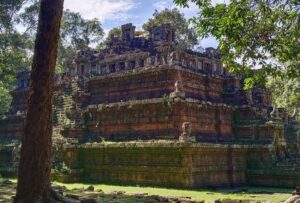
Phimeanakas was built as a three-tiered sandstone pyramid, designed to symbolize Mount Meru, the mythical center of the universe in Hindu cosmology.
Rising steeply above its base, the temple once supported a tower on its summit, although little of this superstructure survives today. Its stepped form and compact design distinguish it from larger, more elaborate temple-mountains but still convey its sacred role within the palace compound.
Cultural & Historical Significance
Phimeanakas was deeply connected to Khmer royal rituals and mythology. According to ancient legend, the king was required to spend each night in the temple with a naga spirit that took the form of a woman. This mystical union was believed to ensure the prosperity of the kingdom, while neglecting the ritual could bring disaster.
The temple thus symbolized not only devotion to the divine but also the political authority of the king. By associating kingship with divine guardianship, Phimeanakas reinforced the image of the monarch as a ruler chosen and protected by the gods. Its placement within the royal enclosure further underscores its role as both a spiritual sanctuary and a political emblem.