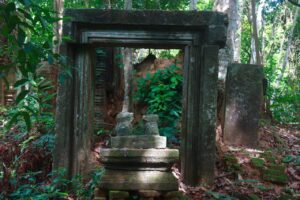
 Located on a serene hill just three kilometers from Stung Treng town, Preah Theat Temple is one of the province’s most sacred and historically important landmarks.
Blending spirituality, history, and artistry, it attracts both worshippers and travelers who wish to connect with Cambodia’s ancient heritage. The site offers not only a glimpse into the architectural achievements of the early Khmer civilization but also a living spiritual tradition that continues to this day.
Historical Background
Preah Theat Temple dates back to the 6th century, during the reign of King Jayavarman I. This period was marked by the expansion of Khmer spiritual traditions and the development of distinctive architectural styles. Originally built as a single-tower sanctuary, much of the temple has been lost to time.
However, the surviving foundation and stair steps still reflect its original grandeur and importance. The temple also endured significant damage during Cambodia’s civil war, but efforts by the Department of Culture and Fine Arts have ensured its preservation. A protective wooden roof now shelters the remains, safeguarding them for future generations.
Architectural Features
Constructed primarily of red brick and sandstone, Preah Theat Temple closely resembles the style of Preah Ko Temple in Thala Borivat District.
Surviving lintels feature intricate carvings, including the mythical Makara sea-dragon, depictions of horses, floral motifs, and an image of Vishnu, highlighting the early Hindu influences in Khmer spiritual life.
Though many carvings are fragmented, they retain a remarkable elegance and provide valuable insight into the artistry of early Khmer builders.
Symbolism & Spiritual Significance
At the center of the site lies the Yoni, one half of the Yoni-Linga pair, which represents divine power, fertility, and cosmic balance. This ancient symbol underscores the temple’s enduring spiritual significance.
Even today, locals and pilgrims continue to visit Preah Theat to pray for good fortune and blessings. This ongoing devotion ensures that the site is more than a historical ruin, it remains a living spiritual landmark where faith and tradition persist.
Visiting the Temple
Reaching the temple requires a short walk or bike ride, as direct vehicle access is restricted due to the narrow path leading up the hill. The location itself adds to the experience: set amid natural greenery, the temple offers a peaceful atmosphere ideal for reflection and meditation.
The wooden protective roof, recently constructed, not only shields the ruins from weathering but also allows visitors to better appreciate the delicate carvings and structural details without further damage.