 Ta Keo – The Majestic Unfinished Temple of Angkor
Rising dramatically to a height of 40 meters, Ta Keo is one of Angkor’s most imposing monuments.
Built entirely of massive sandstone blocks, it was the first temple constructed fully in sandstone, showcasing the ambition and engineering skill of the Khmer Empire. Dedicated to Shiva, Ta Keo stands as both a masterpiece of scale and a mystery of incompletion.
History & Architecture
Construction of Ta Keo began in 975 AD under King Jayavarman V, who envisioned it as a grand state temple symbolizing his power and devotion to Shiva.
After his assassination, his uncle Suryavarman I continued the project, but it was ultimately left unfinished. Unlike most Angkor temples, Ta Keo’s walls and towers remain undecorated, offering rare insight into Khmer building methods, where stone blocks were first placed and later intended to be carved.
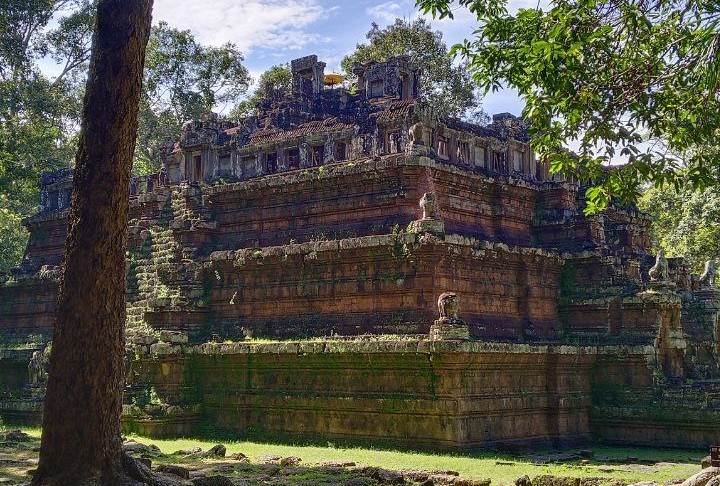
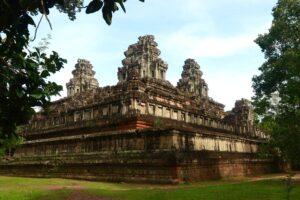
The temple’s design follows a bold and monumental style. Two lower base levels form wide courtyards, while three upper terraces rise steeply to support five sanctuary towers arranged in a quincunx pattern, with one at each corner and a central tower dominating the summit. The central tower, larger and taller than the others, symbolizes the sacred mountain peak, the cosmic center of the universe in Hindu belief.
The layout of Ta Keo is equally impressive. A large moat measuring 225 by 195 meters surrounds the temple, marking its sacred boundary. The main eastern entrance is approached by a 50-meter causeway lined with columns, leading visitors directly to the base. At the summit, lingas and pedestals remain, reminders of the temple’s original religious function. Its first name was Hemasringagiri (“Golden Peak Mountain”), later renamed Jagisvara Pandita under Suryavarman I.
Cultural & Historical Significance
Ta Keo reflects Jayavarman V’s ambition to rival and surpass earlier temples, serving as a clear statement of royal authority and religious devotion. As the first fully sandstone temple, it represents a major turning point in Khmer architectural practice, allowing for greater scale and durability than brick or laterite constructions.
The temple’s unfinished state remains one of Angkor’s enduring mysteries. Historians suggest that work may have halted due to political upheaval, shifting priorities under Suryavarman I, or even a belief in bad omens after a lightning strike during construction. Whatever the reason, the absence of carvings gives Ta Keo a raw, monumental quality unmatched by other Angkor temples.
Ta Keo Symbolism
Ta Keo symbolizes the Khmer kings’ vision of Mount Meru, the mythological home of the gods, with its five sanctuary towers representing the mountain’s peaks. Its sheer mass and towering form reflect strength, stability, and permanence, ideals central to kingship and divine legitimacy.
The temple’s unfinished condition also carries symbolic weight: it stands as a reminder of human limitation, political uncertainty, and the fragile balance between ambition and fate. In its silent, undecorated stones, Ta Keo embodies both the grandeur and vulnerability of the Khmer Empire, a monument to vision left incomplete.