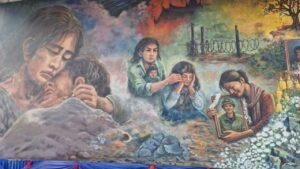
 Khmer Rouge – Cambodia’s Darkest Chapter
The Khmer Rouge regime (1975–1979), led by the Communist Party of Kampuchea under Pol Pot, represents one of the darkest periods in Cambodian history.
Over four brutal years, more than two million people roughly a quarter of the population perished through executions, starvation, forced labor, and disease. Intellectuals, professionals, and anyone suspected of foreign influence were systematically targeted.
This tragedy gave rise to the Killing Fields, sites across Cambodia where mass executions and burials took place.
The term was coined by journalist Dith Pran, a survivor who escaped the regime. Today, these sites serve as somber memorials, ensuring the horrors of genocide are never forgotten.
Wat Thmey (Killing Fields) – Siem Reap
While Phnom Penh hosts the most well-known memorials, such as Choeung Ek and Tuol Sleng (S-21), Siem Reap has its own site of remembrance: Wat Thmey Pagoda.
During the Khmer Rouge era, Wat Thmey functioned as a detention and execution site. Thousands of prisoners were held, often forced to confess to crimes they did not commit, before being executed. Their bodies were buried in nearby pits and wells, with an estimated 8,000 victims in total.
In 1995, during renovations, human remains were uncovered. Today, a glass memorial stupa houses the skulls and bones of the victims, standing as a stark reminder of the atrocities.
The site also hosts a photo exhibition, a collaborative project between USAID and the Documentation Center of Cambodia, depicting forced evacuations and daily life under the Khmer Rouge. Wat Thmey is both a site of memory and a center for education and reflection.
Why Should Visit Wat Thmey
Historical Insight: Visitors gain a sobering understanding of the scale and brutality of the Khmer Rouge genocide. The memorial stupa filled with bones and skulls provides both evidence of the atrocities and a symbol of remembrance.
Memorial & Reflection: The site offers a quiet space to pay respects to those who lost their lives and to honor the resilience of survivors. Sensitivity is essential, as Wat Thmey remains an active site of mourning for the local community.
Educational Value: Exhibitions and displays within the compound shed light on the events of 1975–1979, helping ensure that memories of the genocide endure. Educational efforts stress the importance of remembrance to prevent future tragedies.
Local Connection: Unlike the larger memorials in Phnom Penh, Wat Thmey is less-visited, offering travelers in Siem Reap a chance to engage with Cambodia’s modern history beyond Angkor’s temples. Its location within an active pagoda also highlights the resilience of Buddhist practice following devastation.